Sunday, September 26, 2010

Groupon and Mass Discounting Strategies


Spurred in part by an excellent article written by Chris Jones of the Chicago Tribune, in the past month, there has been a lot of talk about cultural organizations using Groupon (an online, mass discount website). Just like any mass discounting method, using Groupon should be a well thought out strategy. Used correctly, and it can work very well. Used incorrectly, and it can be very costly.

Things to remember about Groupon:
  • It is out there for the world to see and it was designed to be used by social media, so that it is picked up and passed along at a very rapid pace. From some of my previous posts on this blog, you probably know that I am a fan of what I call "ninja discounting." Very rarely do I use mass communication to advertise and promote discounts, preferring instead to use one-to-one direct marketing techniques aimed at very strategic recipients. If I need to discount, then I want to make sure that I can control who gets the discount so that it flies under the radar of full price buyers.

  • Groupon generally rewards a pattern of behavior that isn't desired--namely, last minute ticket purchasing. Before turning to a mass discounting strategy like Groupon, performing arts organizations will wait to see how their standard campaign is doing. If they are on goal, most won't discount. If they are off, time to throw out the offers. But this usually happens pretty late into a campaign. Let's use the Joffrey Ballet that Chris cites as an example. Their programming begins in October, as does Arena Stage's, so I would guess they launched their subscription campaign last spring. How do you think a subscriber who purchased early and at full price will feel when he sees that if he waited several months he could get a subscription at 50% off? and what do you think his purchasing behavior will look like next year? and trust me, he will get the offer because as my first point illustrates, it goes to everyone.

  • Groupon is a for-profit company, and operates like one. They take a significant cut of each sale made. Using the example from the Joffrey Ballet, subscriptions were offered at 61% off regular prices. However, the cut that the Joffrey gets is significantly less than that, so they most likely sold those subscriptions at 75-80% off. Larger organizations can negotiate better splits with Groupon than their smaller counterparts, but I haven't heard of anyone keeping more than 60% of the full sales price.

  • We must always remember that discount buyers behave differently and you must budget for that. Full season subscribers at most organizations renew at a rate between 85% to 90%. However, I have found that full season subscribers that purchase their subscriptions at a drastic discount renew at a much lower rate (around 60%). Additionally, because they spent significantly less amount of money per ticket, the no show rates are also substantially higher, sometimes leaving large empty holes in your house.

Instead of putting subscriptions on Groupon in order to attract thousands of new subscribers, I would do the following:

  1. Using your database, compile a list of the tough holdouts that you have hit up seven to eight times already during your subscription campaign (usually includes single ticket buyers and non-renewed subscribers from the past 3-4 years).

  2. Next, trade lists will all the other arts organizations in town.

  3. Then possibly consider purchasing lists from a list broker.

  4. Combine all the names into one master document, and suppress your current subscribers, donors and full price ticket buyers.

  5. Using the exact same deep discount offer you were going to give to Groupon, develop a cheap, but effective mailer and send to your list. Make sure it is an offer that is impossible to pass up, and that the offer leads in design and has a deadline. (note: if you don't have a large box office staff, then make sure the offer is online only, or you will be swamped). The key is to keep production and mailing costs low--send using non-profit postage and use a discount printer/mail house.

By doing this, you get to keep the entire purchase price of the discounted subscription, and you minimize the possibility that your dedicated and loyal patrons will see that you are heavily discounting late into your campaign after thousands have already purchased.

I find that Groupon is most useful when trying to fill large sections of an empty house on dates that are less desirable. Full price ticket buyers don't seem to mind because they didn't want those dates anyway, and most companies budget low percent paid capacities on those dates so it is additional revenue that wasn't anticipated.

Monday, September 06, 2010

Remember to Test even the "Sacred Cows"


I think I have always been attracted to arts marketing because it allows me to use both creative as well as scientific talents. To this day, I might be the only person to graduate from Missouri State University with a major in speech and theatre education and a minor in mathematics. So it should come as no surprise that I take a very scientific approach to marketing.

In every campaign I lead, I constantly manipulate variables and note outcomes in an attempt to continually improve upon previous results. The easiest variables that marketers turn to are design and pricing. How many times have you tested a carrier package? an offer? pricing strategy? Probably quite a few times. Now think about how many times you have tested different timing schemes for putting products on sale.

This was the first year in my tenure at Arena Stage where we experimented with using timing as a variable. For almost as long as we have had mini-subscriptions, we have put them on sale at the exact same time as our full season subscriptions, fearing that instead of waiting or upgrading, our potential mini-subscribers would opt to go elsewhere for their entertainment. The fear of losing potential mini-subscribers was so strong that for many years timing wasn't even considered a possible variable to test.

As a leader, you have to always remember that the fear of a potential loss will always be significantly more powerful than the possibility of a probable gain. By nature, we are risk averse, and if given a choice to pursue status quo or trail blaze, we will choose status quo each and every time unless there are overwhelming odds. But you have to be mindful of "sacred cows," and be willing to test even the most concrete of assumptions. In my career, the testing of "proven strategies" has led to some pretty remarkable results.
For our inaugural season in the new Mead Center for American Theater, we experimented with exclusively putting full season subscriptions on sale for the first four months of our subscription campaign. In addition, we developed a pricing strategy that encouraged full package purchases, and new exclusive benefits for full season subscribers, such as the ability to purchase parking in our onsite, underground parking lot. It was a test of timing as a variable--would potential mini-subscribers upgrade to the full season, wait until mini-subscriptions were available or leave Arena Stage entirely.

As we are eight months into our subscription campaign, we have some pretty interesting results:
  • we exceeded our projections for full season subscribers both in number of subscribers as well as revenue by almost 60%
  • we had three times as many subscribers upgrade their packages when compared to those that downgraded
  • full season subscriptions weren't just for renewals and upgrades--we more than tripled our projections for brand new subscribers to Arena Stage at the full season level. At this moment, 11% of our entire subscription base are patrons who have never subscribed to Arena Stage and did so in their first year at the full season level.

As our full season subscribers renew at a much higher rate than our mini-subscribers do, I anticipate that the growth that we have seen in our number of full season subscribers will benefit us for many years to come.

Wednesday, August 18, 2010

Some thoughts on Dynamic Pricing

A couple of months ago, a good dialogue about dynamic pricing began when Trisha Mead (PR and Publications Manager, Portland Center Stage) wrote a blog post on the benefits of dynamic pricing on the 2am theatre blog, and then Adam Thurman (Director of Marketing, Court Theatre) wrote a response entitled "the perils of dynamic pricing." It reminded me how often marketers disagree with each other when it comes to so called best practices.

If your organization is considering dynamic pricing, a couple of things to think about from someone who has some experience with it:

1. Tailor all marketing strategies to your organization. How can one pricing strategy be perfect for one organization, and completely wrong for another? The simple answer is every organization is unique, with a unique set of circumstances to consider. For example, if an organization's funding mix is 70% earned and 30% contributed, chances are, they might be much more likely to consider a dynamic pricing model, as ticket sales play a more prominent role in the organization's fiscal health. On the flip side, if your organization is known for more riskier programming, and relies upon contributed revenue more to subsidize less popular work, then dynamic pricing might seem like an alien concept.

2. Be mindful of your organizational culture and brand. Some companies are pioneering and entrepreneurial in nature, always looking for new opportunities to increase revenue streams. Other organizations have a more egalitarian approach to arts consumption. If your organization is known for having low prices available to everyone, then a dynamic pricing model might cause quite a disruption. However, those that argue that non-profits have nothing to learn from for-profit models are naive. There is now a long history of non-profits and for-profits working together. Even the most egalitarian of organizations, a "people's theater" like the Public Theater, routinely relies upon revenue from the for-profit theater world to fund its non-profit mission. Where would the Public Theater be today without A Chorus Line or New York Theatre Workshop without Rent? Sometimes for-profit strategies and approaches can be very beneficial to non-profit missions.

3. The funding conundrum. In his post, Adam asks a question which is meant to imply that the implementation of dynamic pricing could jeopardize an organization's "case for support." I have heard this argument before, and found it intriguing. Over the span of the past few months, I have sat on a couple of major funding panels with representatives from the top national arts foundations. I took the opportunity to ask them about the impact dynamic pricing might have in their opinion on an organization's "case for support." Without exception, each funder recognized that contributed support, especially from foundations and corporations, has taken a significant hit as a result of the global economic crisis, forcing non-profits to devise methods to increase other revenue streams. They understand these strategies in some cases are necessary for survival, and consequently said that they would not have any impact on a funding decision.

4. Dynamic pricing doesn't necessarily mean eliminating accessibility. Most non-profit art organizations would agree that accessibility to art is important. Dynamic pricing in itself doesn't preclude patrons from experiencing a performance if they can't pay top dollar. What it does do is force price sensitive consumers into an early buying pattern. Remember that in most cases, dynamic pricing doesn't affect ticket prices until a venue is at 60-70% paid capacity. If you purchase early, dynamic pricing shouldn't come into play. One of the reasons that I like dynamic pricing is that it rewards a buying behavior that is essential to converting a single ticket patron to a subscriber. Subscribers buy early and in bulk partially to get the best pricing available. If you can train more single ticket buyers that the later they purchase, the higher the price, it teaches the price sensitive single ticket patrons purchasing behaviors more aligned with the purchasing behaviors of subscribers.

Adam and Trisha are both right--dynamic pricing is both beneficial and perilous. Depending upon the needs of your organization, what's good for one, might not be good for all. Makes me start to wonder if there are any such things as general best practices.

Sunday, August 01, 2010

Marketing to our Emotions


Long ago, I read Dale Carnegie's How to Win Friends & Influence People, a book that I think should be required reading for all managers and marketers. The one lesson from the book that remained with me for all of these years, was a reminder that although we like to think of ourselves as rational decision-makers, we are first and foremost emotional beings.

In finishing my reading of Jonah Lehrer's How We Decide, which will be a new required book for my graduate students, I was reminded of a couple of important ways in which emotions override logic in decision-making:

Loss Aversion. The fear of loss is more powerful than the appeal of a gain, so powerful that often times it makes us make irrational decisions. To prove this principle, Lehrer discusses several studies and experiments involving investments. It has been proven over the past seven decades that stocks outperform bonds almost 12 to 1, leading one to question why bonds are so popular. In the early 1950s, an economist named Harry Markowitz won the Nobel Prize for developing an equation for the best investment ratio to ensure optimum performance. However, when it came time to implement his own theory, which supported heavier investments in stocks, he decided it was too risky and invested in stocks and bonds equally. In applying this principle to the performing arts, one could infer that the most powerful marketing message would be a message that demonstrated how one could avoid a loss (instead of acquiring a gain). For example: "Tickets selling out fast! Select dates still available. Don't be left out in the cold--call today!"

Expectation of Price. Arts marketing lore has it that price can affect one's perceived value of a brand. The thought is that selling tickets at a lower price will devalue the experience. According to Lehrer, there is some wisdom to this theory. In his book, he discusses a wine tasting experiment at Stanford. In front of a panel, scientists placed five bottles of wine ranging from $5 to $90, and the panelists were told that each bottle contained a different wine. However, there were only three types of wine, so two types were repeated (actually the $5 wine was placed in the $5 bottle and the $45 bottle). Even though the $5 and $45 bottle contained the exact same wine, the $45 bottle was considered far superior. The scientists followed up with another experiment, this time not listing any of the prices. When the taste test was executed completely blind, the cheapest wine got the highest rating of the group. Using the expectation of price to our advantage, wouldn't it be more beneficial to set the prices of our products a little higher (thereby establishing a higher perceived worth), and then discount if need be, allowing the customer to think that they are getting a bargain? Which is a great segue to...

The Anchoring Effect. Lehrer contends that a meaningless anchor--in many cases a contrived number--can have a strong impact on one's decision-making habits. To bolster his case, he describes a process that most of us are all too familiar with. When purchasing a car, we might first be drawn to the sticker price, even though most of us know that almost no one pays the actual price listed. That's because the sticker price is an anchor which allows the car dealership to sell a car at the actual price and make it look like a deal to the consumer. We leave the dealer thinking we just got a $20,000 car for a few thousand dollars less, when in actuality, we paid what the dealer was hoping for or else we would have never driven the car off the lot. So in our lives, if we need the average ticket price to be $50.00, why not set the price a little higher and discount so that our product's perceived quality is higher and the consumer walks away thinking they got a deal?

The Power of the Personalized One. Good fundraisers use this emotional quirk of our brains all the time. Lehrer examines a couple of experiments by Paul Slovic, a psychologist at the University of Oregon. In his experiment, Slovic shows a group of people a photo of a specific starving child while telling that child's story. Afterward, he asks for a donation to a charity designed to address starvation. For a different group, he provides statistics about starvation throughout Africa--numbers that illustrate the staggering size of the problem, and then he asks for a donation. The funds raised by the second group were 50% less than the first. The lesson -- causes need to be personified and at a scale where a person believes he or she can have an impact. In our daily lives, having a specific child tell how your organization's programming affected them could be more impactful than even the most compelling statistics.

Although not written for marketers or the arts, I would encourage everyone to read Jonah Lehrer's How We Decide. On average I tend to read a book about once a week, and I have found How We Decide to be one of the most challenging and intriguing reads I have had in a very long time.

Tuesday, July 13, 2010

Are you an expert? You must be a failure

Recently I was introduced to Jonah Lehrer at the Theatre Communications Group annual conference in Chicago where Mr. Lehrer was a keynote speaker. His speech inspired an earlier blog post, and convinced me that I should probably read his book How We Decide. I am just about a quarter of the way through it, and I must admit that I am finding it a bit dense, although completely fascinating. Instead of reading right before going to sleep, I am waking up a little early to read because my brain needs to be fresh to process some of his ideas.

In the second chapter of the book, entitled "Predictions of Dopamine," Lehrer examines two subjects--TD Gammon (a computer specifically designed to play backgammon competitively) and Bill Robertie (a man who is a world-class expert in chess, poker and backgammon). In his examination of these two subjects, I learned two amazing lessons:

1. If you want to be an expert, you need to fail a lot! Lehrer quotes physicist Niels Bohr who defined an expert as "a person who has made all the mistakes that can be made in a very narrow field." Demonstrating this principle was TD Gammon. TD Gammon was leaps and bounds better than earlier computers at playing backgammon primarily because it was programmed to learn from its mistakes. When TD Gammon was ready to compete, its inventors wanted it to go up against a world class champion so that it could learn, so they recruited Bill Robertie. In describing his first matches with TD Gammon, Bill said "The first time I competed against TD Gammon, I was incredibly impressed. It represented a big improvement over any other computer program I'd ever encountered. But I knew I was still a better player." The next year, when Bill returned to play TD Gammon after a year's worth of almost a million errors in played matches, it was a different story. TD Gammon had become an expert by studying its own mistakes.

2. It isn't good enough to make errors, you must systematically study them. In determining how Bill Robertie could become a world-class expert in three games, it became clear that his success was linked to his systematic study of his failures. Lehrer quotes Robertie who states "It's not the quantity of practice, it's the quality. The most effective way to get better is to focus on your mistakes." In Lehrer's study of Robertie, he noticed that after Robertie plays a game, he painstakingly reviews what happened, and every decision is critiqued and analyzed. Even when he wins, he insists on searching for errors. In my professional life, I have been accused of being a perfectionist more than once, and direct reports have questioned whether I am ever happy with a result as I constantly analyze decisions, even on the cusp of a great victory. From a management perspective, I can see how that could be construed as having an insatiable appetite for perfection, but I guess I view learning in much the same way as Robertie does. Celebrating success is important, but in situations where you need to learn, and learn quickly, you need to focus on the mistakes even in victories.

Lehrer concludes that "mistakes aren't things to be discouraged. On the contrary, they should be cultivated and carefully investigated." I believe as managers we are responsible for creating environments where admitting mistakes is encouraged, so that as a team, we can all learn from them. In an age where people only want to talk about "best practices," we should also be discussing "worst practices." As it seems to me that you can only get to the "best" by surviving and learning from the "worst."

Recently I was sitting on a funding panel with a representative from a large influential funder, whose organization was supporting projects that could either be great successes or massive failures. It was considered by the funder a "success" to have either outcome, as long as a detailed analysis of each project was made available to the public to learn from. I thought this demonstrated very forward thinking on the funder's behalf, but the funder admitted to me that the public analysis requirement was a significant deterrent to applicants, as they were afraid that public failure would make them less desirable for funding from other sources.

As a field, failure should be celebrated, as long as we are relentless in our analysis of each failure and learn from each incident. Shame should be reserved for those organizations who are complacent in situations that demand change.

Sunday, June 20, 2010

Perpetuating the Myth

I've just returned from the Theatre Communications Group Annual Conference. The theme for the conference was "Ideas into Action," and it built upon the previous year's conference where the field took a look at some of the major issues facing all of us. The idea was to take what we discussed last year and to explore "bold new solutions."

The first session I attended was entitled "Theatres Becoming Centers in the 21st Century." I attended partially because my Artistic Director, Molly Smith, was speaking, but also because I wanted to hear some ideas from other centers from around the nation as we move toward the opening of the Mead Center for American Theater. The one thing that stayed with me through the entire conference from that session was the quote Molly used to open her remarks--she referenced a quote by R. Buckminster Fuller in which he said: "You never change things by fighting the existing reality. To change something, build a new model that makes the existing model obsolete." It made me think that as a field, if we generally agree that our business models have significant issues, then why do we spend so much energy devising band-aids for them instead of building new models that make the existing ones obsolete?

Later that evening, I had the pleasure of listening to a wonderful speech given by Jonah Lehrer, the author of the book "How We Decide: the New Science of Decision Making." He kept me captivated throughout his entire manifesto, but a single story stood out among the rest (well, at least to me). The story goes that Procter & Gamble decided they wanted to invent a new soap to make mopping more efficient. After several months of failed attempts to create this novel soap in house, they hired a creativity firm to work with them. The firm spent nine months studying homemakers as they mopped their floors, and in the end, they concluded that a new soap wouldn't revolutionize mopping because mopping as a means of cleaning was essentially flawed in itself. After observing one woman cleaning up coffee grounds on the floor with a damp paper towel, an idea emerged--what about getting rid of the mop entirely, and fastening a damp paper towel to the end of a stick? And the Swiffer was born.

After more than 50 years of success, where should the resident theater movement look to throw away a mop, and replace it with a Swiffer? In looking back on my scribbled notes, it looks like I came up with four different ideas:

1. Arts Education/Community Engagement. The idea of having an education department at a resident theater is relatively new. Maybe 15 years or so ago, funders started to route resources to student and community programs. Theater companies took note, and started developing more education programming, however the programming was almost always intended to compliment the more "formal" arts education that students were getting in the schools. Fast forward to present day where the focus of our schools have become glued to developing the highest standardized test scores. In this environment, arts education has been highly marginalized, if not all together eliminated. Who is teaching creativity, at a time where we frequently hear from top corporations that creativity is a key component to success in today's ever changing world? Do we need to look at our education departments to figure out how to serve this essential need by ourselves instead of being a complimentary service to our school systems.

2. Subscriptions. Where is our generation's Danny Newman? When he invented the subscription, it revolutionized how performing arts organizations did business, and it mirrored how a certain generation wanted to "consume" artistic product. Baby Boomers joined Kiwanis clubs, went to church, participated in bowling leagues, and purchased tickets to a large number of shows well in advance at discounted prices. But times have changed--Generation X doesn't act like its predecessor, but we are still using the same sales techniques on them that have worked for decades with Mom and Dad. How do we continue to serve Baby Boomers as they still have the largest disposable income, and work to meet the needs and buying habits of Generation X and the Millenials? We can keep slapping band-aids on the subscription model, by doing things like introducing smaller and smaller "pick your own" packages, or acknowledge that we may need a new mop to clean up this particular problem.

3. Development vs. Marketing. If you read my previous post entitled "The Problem of Silos," you know this is an issue that I have been stuck on for awhile. In my career, I have worked at some amazing organizations both incredibly large and very small, and I can honestly say I have never seen an operation that integrates the needs and priorities of marketing and development well. Almost always, one wins out over the other, the cause of which usually can be tracked back to funding and/or leadership. To solve this, a few organizations have developed external affairs divisions that house both marketing and development activities, however those departments are just as segregated under a Director of External Affairs as they would be under an Executive Director. I proposed a new system in my prior post, but this type of change is daunting considering it would mean dismantling and rebuilding the entire revenue generating departments of an organization.

4. Funding vs. Accessibility. There are a multitude of reports out that show that funding has dropped during the global economic crisis, which has put more and more pressure on earned revenue sources to make up the difference. On the 2amt blog, there has been a heated debate on dynamic pricing, particularly as it is used by non-profit theaters. For those unaware of dynamic pricing, the basic premise is that ticket prices for popular productions are increased as demand increases. Is it a coincidence that dynamic pricing has really gained ground and become almost standard practice during the two years following the start of the global economic crisis? If there is less funding, then we need to make more money in ticket sales. Seems logical to me. The problem is that many times, we are doing excellent work in education and outreach programs that reach populations that will never be able to afford a ticket at our institutions. This used to be addressed by funders who supported lower priced tickets, but as that money has dried up, to keep afloat, institutions have cut discounting programs. So where does that leave us? For me, I have become more and more interested in finding new revenue streams--and hopefully new streams that aren't dependant upon the fickleness of reviews either.

As I wrap up this post, I am more cognizant than ever that as a professor of arts management, the techniques that I am teaching my graduate students are antiquated. I call them "best practices" when a more appropriate title might be "yesterday's best practices." If I continue to teach how I was taught, aren't I just perpetuating the myth that our arts organizations are healthy and ready to take on the challenges of the 21st century? Maybe I should begin my classes by challenging them to throw out the mop.

Sunday, June 06, 2010

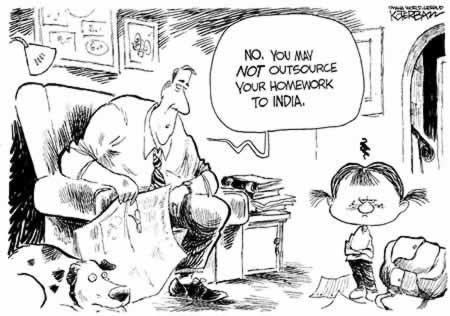
Outsourcing: Make sure to consider the CONs as well as the PROs

A couple of weeks ago, NPR ran a story entitled "Everyone Else Outsources, So Why Can't the Arts?" Since that time, the story has stuck with me. One positive result of the global economic crisis is that it has forced mature organizations to rigorously examine business practices, many of which haven't changed since the publication of Danny Newman's Subscribe Now! I am consistently amazed at the number of organizations that choose to remain stagnant because change is scarier than doing nothing and watching failure creep up to the doorstep. I applaud organizations that are taking steps to inform the field, as successes and failures will provide beneficial data we can use to plan our next steps. And while I have been accused on many occasions of being too aggressive with implementing change, in this case, I am reminded of a saying that a wise professor in graduate school would always say to me--"just because it is new, doesn't mean it is better."

Let me begin by saying that I support the outsourcing of activities that involve highly specialized tasks. Even in large organizations, most of us are generalists with maybe an area or two of specialized training. In unusual circumstances, many times we need to draw upon an expert with a lot of experience in a certain area. As we approach the opening of the Mead Center for American Theater, I am working with several outside companies that we are outsourcing very specific tasks to including Boneau/Bryan-Brown, SpotCo, Target Resource Group, SD&A, Mires+Ball, Shugoll Research and Allied Live.

Although we outsource work to some of the best companies in the business, we wouldn't be successful unless we supervised their work closely. The best outcomes are usually a result of forming very tight partnerships between on site institutional managers and specialists at the outsourcing firms. One without the other usually ends with mediocre work. In fact, I can't remember a single instance in my career where I hired an outside firm and it removed as much work from my desk as I had hoped for.

In addition, as Russell Willis Taylor asks in the article, one must consider the opportunity cost of outsourcing, particularly in areas of customer service and development. For those of us lucky enough to have been TicketMaster clients in our careers, we know how hard it is to get outsourced sales agents on message and equipped to provide excellent service to our customers (I even tried delivering baked goods weekly to call centers). How can an outsourced entity be as passionate as you are about your institution, and isn't that passion crucial in developing fundraising activities? And we don't like to admit it, but in some cases, we are in competition with one another. In purchasing ads, setting up promotions, pitching stories to the press, calling in favors, taking advantage of remnant space--when you are working with 10-20 arts organizations in the same town, who gets priority when undoubtedly there will be times when the interests of these organizations conflict with each other?

I am eager to see how this experiment in Columbus pans out. To me, this model creates many more questions than it provides solutions, however I think they should be commended for taking an innovative step that I am sure will inform the field in the future.

Just a sidenote--I wonder what BP thinks of outsourcing its drilling rigs at the moment?